What writing a Horizon Europe proposal can teach us about expert perspectives, consortium alignment and telling one coherent research story
A story for anyone preparing to write their first Horizon Europe proposal.
Everyone knows the story of Snow White.
A jealous Queen, a magic mirror, a poisoned apple, seven dwarfs and a sleeping princess who recovers after a kiss. We may remember slightly different versions, but we recognise the characters, the sequence of events and the ending.
Now imagine asking a consortium of researchers and innovators to rewrite Snow White as a European research proposal.
Everyone knows the story. Everyone understands it. Everyone sees it through the lens of their own valuable expertise.
And everyone begins writing.
The clinical researcher sees a poisoning case and the need to protect Snow White’s health. The psychologist sees the Queen’s behaviour and its consequences. The technology partner examines the mirror and the information it provides. The ethics researcher questions the decisions made on Snow White’s behalf. The social scientist considers her living circumstances and support network. The implementation specialist asks whether an intervention designed for one cottage could work across an entire kingdom.
And they are all right.
But by the time their contributions are assembled, are they still telling the same story? Or has each expert written a different version of Snow White?
We were all reading the same book — Kennis’s story
At Add Lemonade, we recently participated in a Horizon Europe research proposal alongside an experienced, multidisciplinary consortium.
Our contribution centred on Kennis, a digital health innovation developed around a familiar problem: people receive laboratory results, medical reports or other health information without necessarily understanding what that information means in their particular circumstances.
Kennis aims to make complex health information more understandable and meaningful to the people receiving it. The wider ambition of our proposed research, aligned with the Horizon call, was to investigate whether improved understanding could contribute to reducing low-value care—healthcare activity that offers little or no benefit to the patient.
Like Snow White’s story, ours involved a digital tool. But it also involved much more than the tool itself: clinical practice, patient behaviour, communication, health literacy, evaluation, ethics and implementation across different healthcare settings.
We had the expertise to examine those dimensions. We shared the ambition. We understood the problem.
Yet our proposal was unsuccessful.
Looking back, we were still following the same storyline. But as we developed its details through our different perspectives, some of the connections between events became less convincing. A reader could recognise the story we wanted to tell without being able to follow clearly how one part led to the next.
And in a research proposal, those connections matter. They are what turn a promising idea into a credible investigation.
How, then, can a group of people understand the same problem and still develop different interpretations of the research needed to address it?
Perhaps because expertise does not simply provide answers. It also shapes the questions we ask.
Each discipline trains us to recognise particular problems, identify particular risks and look for particular forms of evidence. The challenge is to turn those perspectives into one coherent research story.
Snow White’s welfare is the objective — not the mirror
Let us return to the fairy tale, this time through the lens of our proposed research.
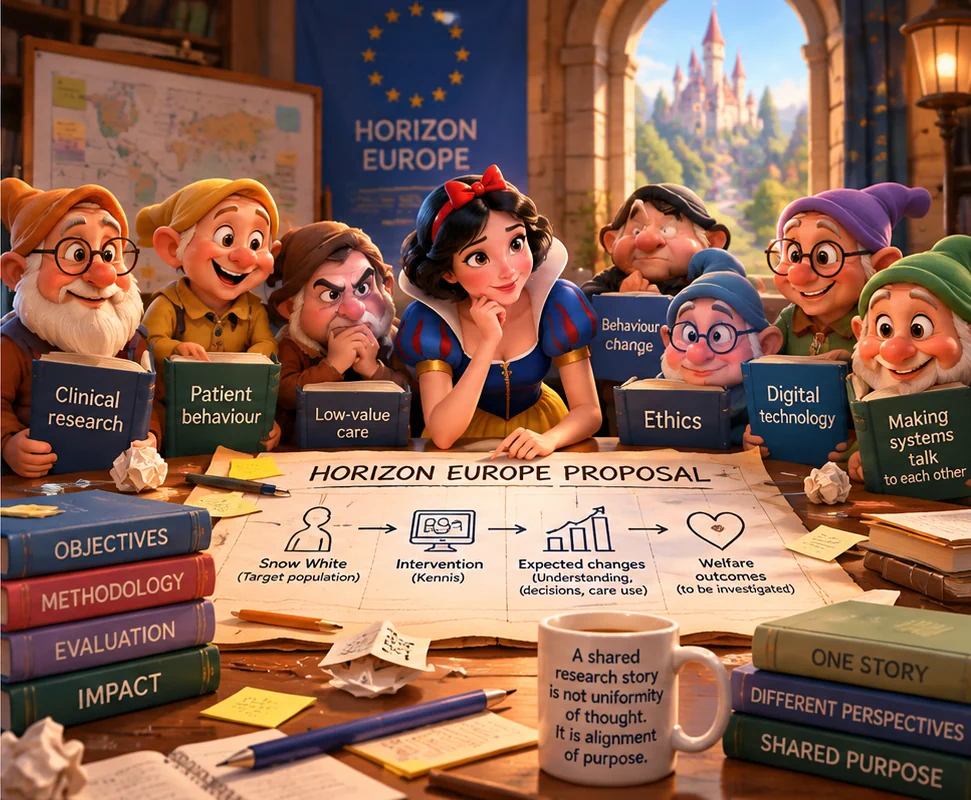
Imagine that Snow White represents the target population and that her welfare is the central concern. The consortium’s purpose is not simply to build a better mirror, study the Queen in isolation or produce seven excellent but disconnected reports. It is to understand the threats to Snow White’s welfare and investigate how those threats might be addressed.
The mirror is important. It provides information, influences behaviour and contributes to what happens next. In our parallel story, it resembles a digital platform: a tool that may affect how people receive, interpret and act upon information.
But the mirror is not the person we are trying to help. And improving the mirror does not, by itself, demonstrate that Snow White will be safer.
The technologist might improve the information the mirror provides. The psychologist might investigate how that information influences behaviour. The clinician might identify the consequences of poisoning and the care Snow White requires. The social scientist might examine whether her circumstances provide adequate protection and support.
And they are all right. Again.
Each contribution helps us understand a different part of the problem. But together, they must explain how the proposed intervention connects to Snow White’s welfare.
What exactly are we trying to prevent or improve? Which factors can our intervention influence? What changes do we expect? And how will we establish whether those changes have genuinely benefited her?
Without that shared logic, our consortium of storytellers risks demonstrating that the mirror works, the clinical assessment is sound and the behavioural analysis is insightful—without establishing whether the overall intervention improves Snow White’s situation.
The same distinction matters in digital health. A platform may improve how information is communicated, and patients may understand that information more accurately. But whether this leads to safer decisions, more appropriate healthcare use or better outcomes is a further research question.
In our case, better understanding might not even mean fewer healthcare appointments. It could help someone recognise that they do need appropriate professional care. Reducing unnecessary care and ensuring access to necessary care are not the same thing.
That is why the pathway between an intervention and its intended outcome must be investigated, not assumed.
The technology is part of the intervention. The person’s welfare is the reason the intervention exists.
Seven dwarfs, seven work packages?
Imagine each dwarf is responsible for a work package.
Each understands their task and has the skills to deliver it. One gathers evidence. Another develops the technology. Another leads clinical studies. Another evaluates outcomes. Others address ethics, communication and implementation.
Their individual contributions may be excellent.
But does the evidence gathered by one partner inform the intervention designed by another? Are the clinical studies investigating the same underlying question? Do the evaluation measures reflect the outcomes promised at the beginning?
And, most importantly, can every partner explain how their work contributes to Snow White’s welfare?
A consortium does not become integrated simply because its members appear in the same work plan. It becomes integrated when their work is connected by a shared understanding of the problem, the intervention and the evidence needed to assess its effects.
Otherwise, we may end up with seven beautifully written chapters that do not quite form one book.
A Horizon proposal cannot rely on a magical kiss
There is another detail we all accept in the original fairy tale: Snow White eats the poisoned apple, falls into a deep sleep and eventually recovers after a kiss.
As readers, we accept the ending because it belongs to a fairy tale.
Now imagine presenting that sequence to research evaluators.
What caused the recovery? Why should a kiss reverse the effects of poisoning? What evidence supports that mechanism? How will it be tested? Would the same intervention work for other people, in different circumstances?
Suddenly, the familiar ending is no longer sufficient.
The proposal must explain how the intervention is expected to produce the outcome, which assumptions support that expectation and what evidence the research will collect to test it.
A convincing impact statement cannot repair a missing connection in the research logic. Nor can the expertise of the consortium substitute for explaining that connection.
In a fairy tale, we can accept the magic. In research, we have to investigate it.
One story does not mean one perspective
The answer is not to ask everyone to abandon their expertise.
Snow White would be a poorer story if we removed every character except the narrator. Different perspectives give multidisciplinary research its depth. They reveal risks, opportunities and consequences that no single discipline could identify alone.
But the consortium needs to agree on the central storyline before each specialist develops their contribution.
The clinician does not need to become a software engineer. The engineer does not need to become a behavioural scientist. Each brings something the others cannot.
What they do need is a shared understanding of how their work contributes to the same research question. The objectives, intervention, clinical studies, evaluation measures and expected outcomes must follow one another—and the proposal must explain those connections in a consistent voice.
This alignment cannot be left until the final editing stage, when everyone has already written their chapter. It needs to guide the writing from the beginning.
For us, the experience reinforced that assembling a capable consortium and writing a coherent research proposal are two different achievements. The first makes the second possible; it does not guarantee it.
We were all reading the same book. We all knew how to read it. But when we began writing the next chapter together, each of us naturally saw the story through our own expertise.
The lesson we are taking forward is not to value those perspectives less. It is to connect them more deliberately around the person, the problem and the question the research is intended to answer.
A shared research story is not uniformity of thought. It is alignment of purpose.
And before we promise Snow White a happy ending, we need to show how our research will establish whether the ending is possible.