
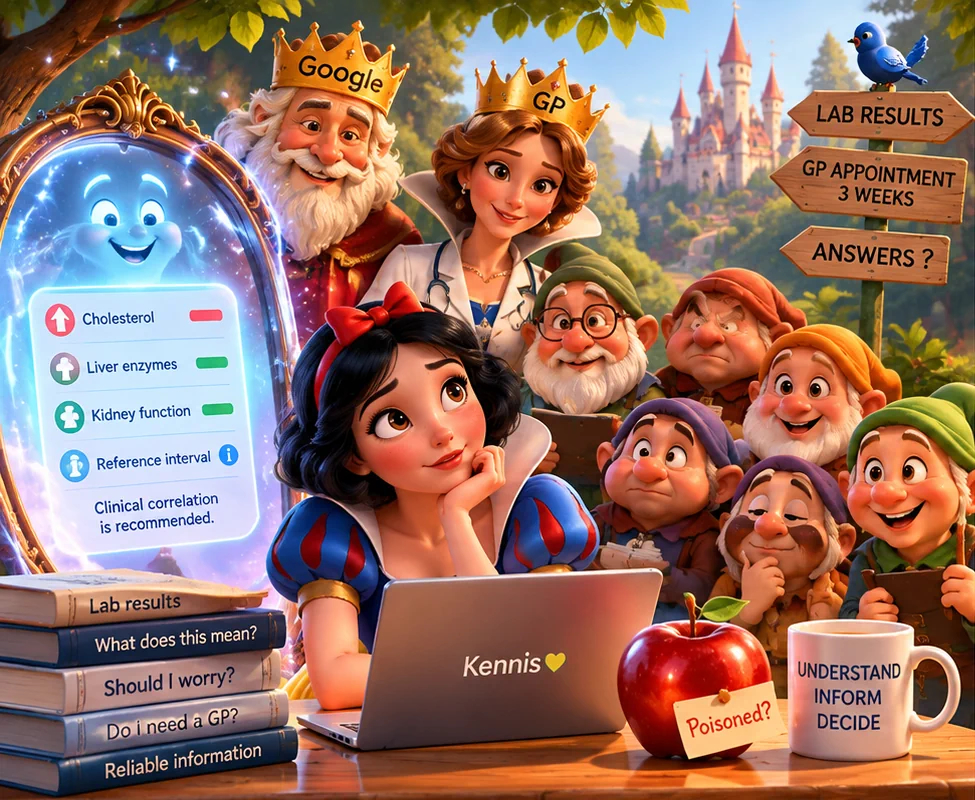
A fairy tale for grown-ups about understanding health information when a blood-test result raises more questions than answers.
Once upon a time, in a kingdom not so far away, there lived a King, his beautiful wife and their little daughter, Snow White. The princess was kind, curious and rather trusting. She knew very little about healthcare, but whenever something worried her, she could always rely on her parents.
Her father, King Google, had an answer for everything. Sometimes he had several million answers. A headache might mean dehydration, stress, a rare tropical disease or imminent death, depending on which scroll Snow White opened first. His advice was not always consistent, but he was available day and night, and she loved him dearly.
Her mother, Queen GP, was considerably more knowledgeable. She knew Snow White’s history, understood her circumstances and could distinguish between something that required attention and something that did not. Unfortunately, she was also responsible for the health of the entire kingdom. Her appointment diary was overflowing, the waiting room stretched beyond the castle gates, and the next available consultation was three weeks after the next full moon.
Still, between her father’s endless answers and her mother’s professional judgement, Snow White felt reasonably safe.
Then, one winter, King Google became obsolete. He left behind an enormous library of outdated articles, contradictory advice and several thousand bookmarks. Snow White was devastated. Queen GP had little time to mourn: the kingdom still needed running, the patients still needed seeing, and the appointment system had crashed again.
In time, the Queen remarried. Her new husband was a powerful and sophisticated technology called Artificial Intelligence. He was fast, confident and capable of processing more information before breakfast than King Google had managed in his entire lifetime. He brought with him a magnificent magic mirror.
Every morning, the mirror displayed Snow White’s latest laboratory results: haemoglobin, cholesterol, liver enzymes, kidney function—beautiful numbers, colourful indicators and the occasional alarming red flag.
Snow White stared at them.
“What does it all mean?” she asked.
“Your result is outside the reference interval,” replied the mirror.
“Is that bad?”
“Clinical correlation is recommended.”
“Should I worry?”
“Please consult your healthcare provider.”
Snow White sighed. Her mother was booked until Thursday. Three Thursdays from now.
The mirror, despite being extraordinarily intelligent, had apparently never met Snow White. It knew her numbers. It did not know her story.
One morning, a new result appeared beside a little red apple. Snow White clicked it. The mirror produced a long explanation containing words she had never encountered before. She read it once, then twice, and finally searched for their meaning. Within minutes, she had discovered seventeen possible conditions, four dietary supplements, a discussion forum and a woman on social media who claimed to have cured the same result with celery juice.
Snow White became frightened. She called her mother, but the receptionist explained that all appointments had been taken.
“Is it urgent?” the receptionist asked.
“I don’t know,” said Snow White. “That’s why I’m calling.”
She was advised to call again tomorrow. And the following day. And the day after that.
Meanwhile, the magic mirror continued displaying the same result. It was technically accurate, beautifully designed and completely unhelpful.
Deep in the forest lived seven specialists. Doc understood clinical medicine. Happy studied patient wellbeing. Grumpy investigated unnecessary healthcare use. Sleepy researched behavioural responses. Bashful specialised in ethics. Sneezy understood digital systems. And Dopey was responsible for interoperability.
Together, they possessed almost every skill required to help Snow White. Unfortunately, they had never quite agreed on what her problem was.
Doc wanted to investigate the abnormal result. Happy wanted to reduce her anxiety. Grumpy wanted to prevent unnecessary appointments. Sleepy wanted to understand why she kept checking the mirror. Bashful wanted to ensure she could make informed decisions. Sneezy wanted to improve the information displayed. Dopey wanted everyone to stop using different data formats.
And they were all right.
But Snow White was still sitting in her cottage, frightened by a number she did not understand.
One day, a traveller arrived in the kingdom carrying something called Kennis. It was not another magic mirror, nor did it claim to replace Queen GP, diagnose Snow White’s condition or make decisions on her behalf. Its purpose was to help people understand the health information they had already received, in language and context that made sense to them.
Snow White showed Kennis her result. For the first time, the conversation began not with the number, but with the person looking at it. What did she understand? What was confusing her? What did she need to know? And when might professional advice be appropriate?
The seven specialists gathered around. Doc explained the clinical context. Happy considered Snow White’s experience. Sleepy explored how the information might influence her behaviour. Bashful ensured that Snow White remained involved in decisions about her care. Sneezy worked on making the information accessible. Grumpy asked whether the approach might prevent unnecessary consultations. Dopey finally managed to connect the mirror to the cottage’s electronic records.
Everyone celebrated.
Until Snow White asked, “Does this mean I won’t need to see my mother anymore?”
“No,” said Doc.
“Will I stop worrying?”
“Not necessarily,” said Happy.
“Will I need fewer appointments?”
“We don’t know yet,” admitted Grumpy.
“Then what exactly are you promising me?” asked Snow White.
And that was when the kingdom realised that understanding information, changing behaviour and improving healthcare outcomes were three different things.
They had a promising idea, an experienced team and a person who needed help. But they still had to establish how their contributions would work together—and what evidence would show that Snow White’s welfare had genuinely improved.
The following morning, the King summoned the specialists.
“I hear you have developed an intervention that helps people recognise which apples might be dangerous,” he announced.
“We have developed an approach that may help people understand health information and make more informed decisions,” replied the specialists.
“Excellent! So how many poisoned apples will it prevent?”
The specialists looked at one another. They could measure Snow White’s understanding. They could study her confidence and how she used Kennis. But they had not yet established whether the intervention would prevent harm, whether it would work for other people or what might happen under different circumstances.
“A promising idea,” said the King, stroking his beard. “But a supposition is not yet evidence. If you want me to believe that understanding the apples will improve people’s welfare, you must show me how you intend to prove it.”
And so the seven specialists sat down to write a proposal to the Royal Research Council. Each wrote an excellent chapter. Doc wrote about clinical safety, Happy about wellbeing, Grumpy about reducing unnecessary clinical visits, Sleepy about behaviour, Bashful about ethics, Sneezy about technology and Dopey about making all the systems talk to each other.
They assembled their chapters, submitted the manuscript and waited.
Several months later, a letter arrived. The kingdom had not received funding.
The reviewers recognised the specialists’ expertise and the promise of their idea. But they could not clearly follow the path from Snow White’s problem to the proposed intervention, or from the intervention to the improvements in her welfare that the specialists hoped to demonstrate.
The seven were disappointed. They had all read the same story. They had all understood their own chapters. They had all written with knowledge and care. But somewhere between the first page and the final chapter, Snow White had become seven different research questions.
So they gathered around the table once more. This time, instead of beginning with their own expertise, they began with Snow White.
“What are we trying to change in her life,” they asked, “and how will we know whether we have changed it?”
Only then did they begin writing the story together.
And they all lived happily ever after.
Well, not quite.
Snow White was still waiting for her GP appointment.