

Why successful cancer treatment is only part of the story—and why understanding what happens afterwards matters.
Imagine two patients. Both are 76 years old. Both receive the same cancer diagnosis, undergo similar treatment and achieve a favourable clinical outcome. Six months later, their medical records tell remarkably similar stories. Their everyday lives, however, do not.
One has returned to gardening, shopping, meeting friends and enjoying Sunday lunch with the family. The other has stopped driving, struggles with the stairs, rarely leaves home and increasingly relies on a spouse who is also getting older. From an oncology perspective, both may have responded well to treatment. But have they experienced the same recovery? And perhaps more importantly, would they describe their outcomes as equally successful?
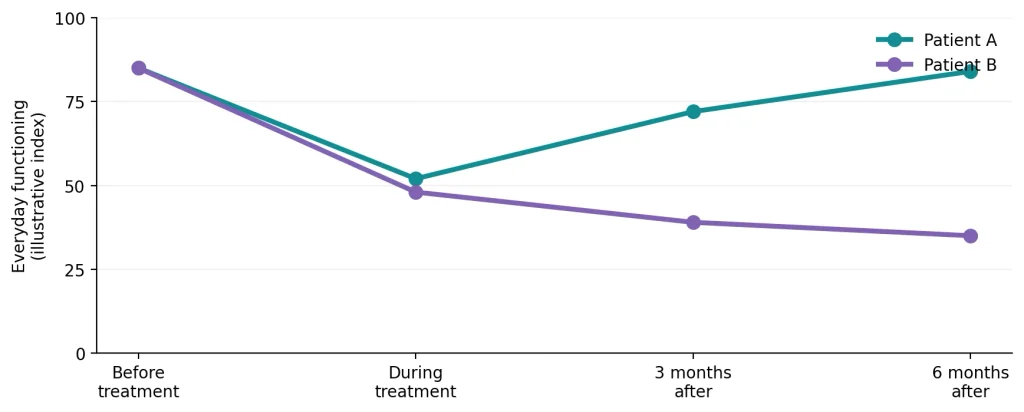
Modern cancer care has made remarkable progress. Earlier diagnosis, increasingly personalised treatments and improved supportive care have changed what is possible for many patients. Yet for older adults, cancer rarely arrives in isolation. A person may already be managing arthritis, diabetes, cardiovascular disease, reduced mobility or several medications. They may live alone, care for a partner or depend on public transport to attend appointments. Cancer treatment enters an existing life, with existing routines, responsibilities and vulnerabilities.
A treatment that is clinically appropriate may nevertheless be difficult to tolerate. Fatigue can make shopping exhausting. Reduced mobility can turn a short walk into a challenge. Anxiety about falling can gradually reduce confidence. Sometimes the consequences extend well beyond the treatment itself. The person who once walked to the shops begins ordering groceries. Then stops attending a weekly social group. Eventually, leaving the house becomes something to avoid rather than enjoy. No single event necessarily looks dramatic, but together these changes can transform someone’s life.
This is not an argument against effective cancer treatment, nor a suggestion that clinicians ignore quality of life. Geriatric oncology, rehabilitation, supportive care and patient-reported outcomes already recognise many of these concerns. The more interesting question is whether healthcare systems can consistently identify, connect and respond to such changes as they unfold, particularly when they happen gradually and across different aspects of everyday life.
Consider Margaret, a fictional 76-year-old woman who lived independently before her cancer diagnosis. She cooked, drove locally, managed her medication and visited friends. During treatment, she became increasingly tired. Her daughter began helping with shopping, and her husband took over most household tasks. Three months later, Margaret’s treatment had achieved its intended clinical objective. At a follow-up appointment, she reported that she was managing reasonably well.
And perhaps she was. But what does reasonably well mean?
Margaret no longer drives. Her husband now does the cooking. She avoids the stairs whenever possible and has stopped visiting friends because the journey feels too tiring. She hasn’t necessarily experienced a new medical emergency. Instead, her circumstances have changed gradually, and the household has quietly adapted around her. Her husband does a little more, her daughter visits more frequently, and Margaret asks for a little less. Everyone adjusts. Eventually, the new arrangement begins to feel normal.
“We may not know how far today is from the life she was living six months ago.”
This is where longitudinality becomes particularly important. Rather than treating each appointment as a separate snapshot, a longitudinal approach considers how someone’s health, abilities, circumstances and priorities change over time. What could Margaret do before treatment? What became difficult during treatment? What has recovered? What remains challenging? And which of those changes actually matter to her?
A single quality-of-life assessment can provide valuable information. Repeated assessments can help reveal a trajectory. But collecting information over time is only the beginning. Someone must be able to interpret what has changed, understand its significance and decide whether a response is needed.
Healthcare information is often organised around clinical encounters, diagnoses, treatments and individual services. Everyday life is not organised that way. Margaret’s oncologist may know her treatment response. Her physiotherapist may understand her mobility difficulties. Her GP may know about her other conditions. Her daughter may be the first to notice that Margaret has stopped leaving the house. Each holds part of the picture, but no single perspective necessarily captures the whole experience.
Consider something as ordinary as preparing a meal. For one person, being able to cook again might be a minor milestone. For Margaret, who has always loved hosting family lunches, it may represent independence, identity and the return of something she values deeply. A clinical assessment may record reduced stamina. A functional assessment may identify difficulty standing for long periods. Margaret might simply say, “I want to make Sunday lunch again.”
All three pieces of information matter, but they are not interchangeable. Understanding a person’s health also means understanding what changes in health make possible—or impossible—in their everyday life.
Personal priorities can change as well. At diagnosis, Margaret may prioritise survival. During treatment, she may be most concerned about tolerating the next cycle. Afterwards, she may want to regain her independence. None of these priorities invalidates the others, and none should be assumed simply because of her age. Good care needs to recognise that the person making decisions today may have different concerns from the person who began treatment several months earlier.
This relationship between clinical outcomes, everyday functioning and changing personal priorities is central to SENECON, a research and innovation concept exploring how cancer care for older adults might better understand the person across their treatment and recovery journey. SENECON starts from the recognition that a person’s experience of cancer is influenced by more than tumour characteristics or treatment response. Frailty, mobility, other health conditions, psychological wellbeing, informal support, home circumstances and personal goals can all influence what someone is realistically able to manage. These dimensions are already recognised in different areas of healthcare, but bringing them together consistently, and maintaining that understanding over time, presents a substantial research and implementation challenge.
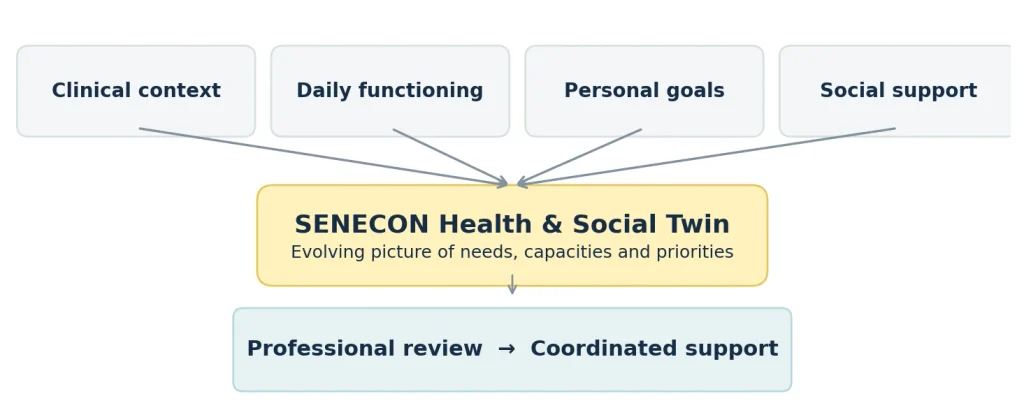
One proposed element of SENECON is a Health & Social Twin. The term digital twin often brings to mind a sophisticated virtual replica of a machine or human body. Here, the concept is different. The ambition is to explore an evolving representation of the person’s clinical situation, functional abilities, vulnerabilities, circumstances and priorities, bringing together selected information that may otherwise remain scattered across different services and encounters.
For Margaret, such an approach could help make visible the relationship between increasing fatigue, reduced mobility, growing reliance on family support and declining social participation. Individually, these observations might appear manageable. Considered together, and compared with her earlier circumstances, they may suggest that her recovery is moving in a direction that deserves attention.
Perhaps rehabilitation would help. Perhaps nutritional support is needed. Perhaps the main obstacle is transport, confidence or the increasing burden on her husband. Or perhaps Margaret is content with her new routine and has other priorities. The answer cannot come from a digital model alone. Technology may help make changes visible, but the person and qualified professionals must determine what those changes mean and what, if anything, should happen next.
This distinction is important because healthcare innovation has become remarkably capable of collecting information. We can measure activity, record symptoms, calculate scores, identify risk factors and display increasingly complex dashboards. Yet there is a danger of measuring everything and understanding very little.
Imagine a system that records Margaret’s declining walking distance, increasing fatigue and reduced social activity with impressive accuracy. The information is available, the graphs are beautifully presented, and every change has been assigned a score. Meanwhile, Margaret remains at home, unable to visit her friends. The technology may have performed exactly as designed. But what has it achieved for Margaret?
More information is not automatically better care. Longitudinal data becomes valuable when it helps answer practical questions. What has changed? Does the change matter to this person? Is action needed? Who is responsible for responding? And did the agreed support actually happen? Otherwise, we risk creating an exceptionally detailed history of a problem nobody addressed.
This is why SENECON’s proposed direction extends beyond monitoring. The concept explores how longitudinal understanding could support coordination between oncology, geriatrics, rehabilitation, nutritional care, psychosocial support and social services. Rather than replacing professional judgement, a Health & Social Twin could help maintain a shared picture of changing needs, agreed goals and actions requiring attention. Whether this approach can improve coordination or patient outcomes remains a question for research and evaluation, not an established result.
There is also a broader question about what constitutes a good outcome at 76. For one person, success may mean returning to work or travelling independently. For another, it may mean managing pain, spending meaningful time with family or continuing to live at home. Some people may willingly accept considerable treatment burden for a particular clinical benefit, while others may place greater importance on preserving mobility or avoiding prolonged hospitalisation. These are personal judgements, not conclusions that should be drawn from someone’s age.
Clinical outcomes remain essential. Survival, treatment response and disease control matter enormously. But they do not tell the entire story. The challenge is to understand how clinical evidence, everyday functioning and individual priorities relate to one another, especially when all three may change over time.
Now imagine Margaret returning for another follow-up appointment. Her results are reassuring. Her treatment has worked as intended, and that is genuinely good news. Before the appointment ends, however, someone asks what she most wants to be able to do again. Margaret thinks for a moment.
“Sunday lunch. I used to have everyone round. I haven’t managed it for months.”
It is not a tumour measurement. It is not a laboratory result. It may never appear in a conventional clinical outcome table. But it tells us something important about what recovery means to Margaret. Perhaps it also gives her care team a more meaningful goal to work towards.
The challenge for future healthcare innovation is not to choose between treating disease and supporting the person living with it. It is to understand how the two are connected, how that relationship changes over time, and how care can respond. Because when we say a patient is doing well, we should know what we mean.
We know what happened to the cancer. Do we know what happened to the person?
About SENECON
SENECON is a research and innovation concept exploring longitudinal, person-centred approaches to cancer care for older adults, including the potential role of a Health & Social Twin in supporting understanding and coordination across clinical, functional and social dimensions. The concept is exploratory and has not yet demonstrated clinical effectiveness.