
Scientific novelty and public availability are not the same thing.
Imagine standing in front of the ruins of a medieval castle.
There are walls, fragments of towers, a few information boards and perhaps a rather enthusiastic visitor explaining to their children that people used to live here.
You look around. You can see the stones. But can you really picture the place?
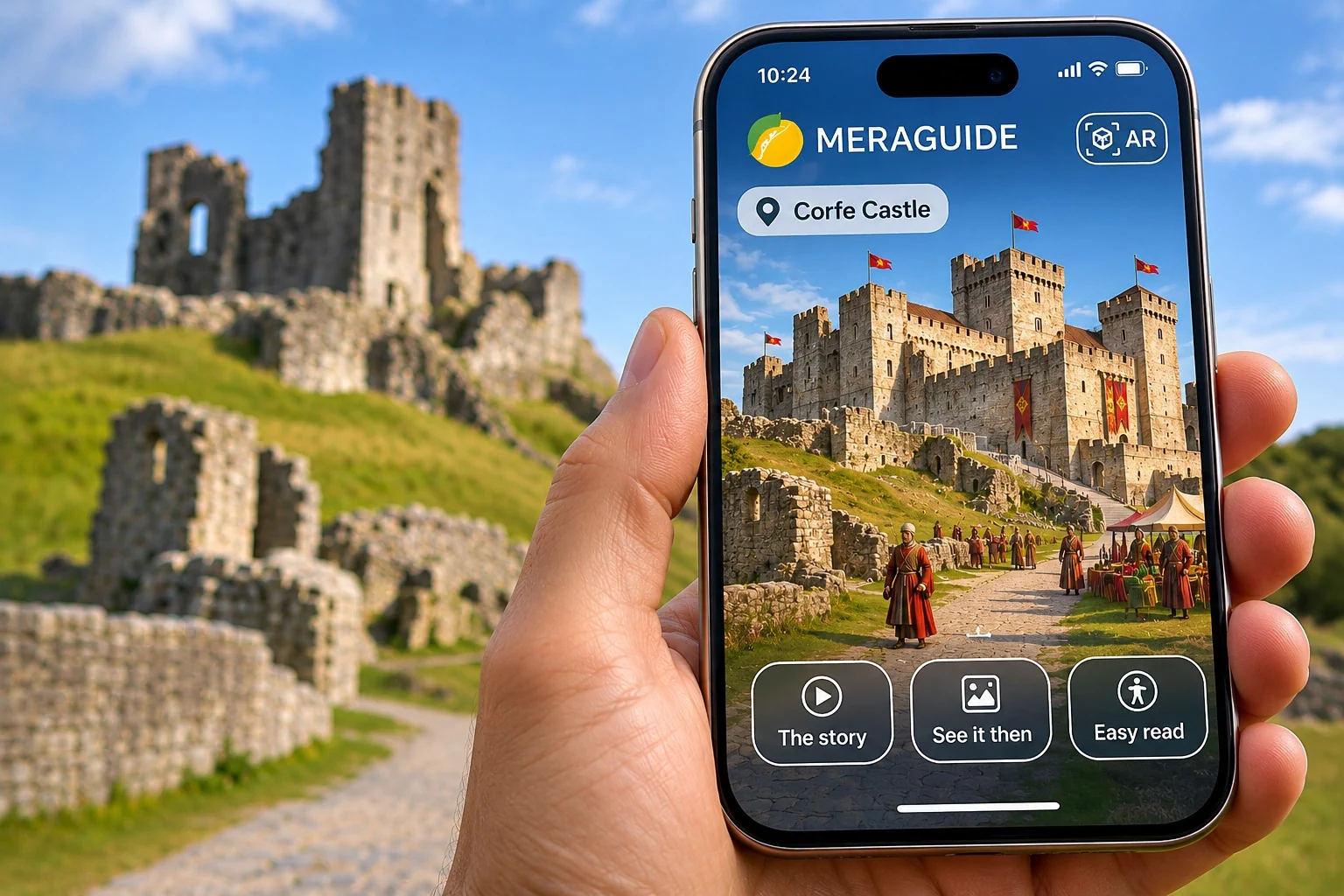
Now imagine taking out your phone, telling an AI companion where you are, and watching the castle come back to life.
The towers rise again. The missing buildings reappear. You see how the rooms might have looked, hear stories about the people who lived there and discover what happened within those walls.
You can ask questions. You can explore the history at your own pace. If you prefer simpler explanations, the experience adapts. If you have a learning disability, the information could be presented in a way that is easier for you to understand.
And tomorrow, when you visit another castle, a Roman settlement or a historic cottage, you use the same application.
No separate app for every attraction. No requirement for each museum to commission its own digital reconstruction.
That was the original idea behind MERAGUIDE, a concept we explored at Add Lemonade.
We thought it was rather exciting.
Then we started researching it.
And, as often happens in innovation, things became complicated.
Apparently, Someone Has Already Thought of That
We discovered that augmented reality can reconstruct historic buildings. Artificial intelligence can generate historical imagery. Digital guides can explain museum collections. Accessible technologies can simplify information and support visitors with different needs.
Wonderful!
We weren’t disappointed to discover that other people had been working on these problems. Quite the opposite. Existing research and technology could make a solution like MERAGUIDE more achievable.
But it also raised an awkward question.
If the underlying capabilities have already been researched, what exactly would make our proposal scientifically novel?
So we explored another direction.
What if MERAGUIDE focused on visitors with learning disabilities, helping them understand unfamiliar environments, interpret information and enjoy experiences that might otherwise be difficult to access?
We investigated that too.
Again, we encountered research into cognitive accessibility, personalised guidance, sensory needs and adaptive digital support.
We expanded our thinking beyond museums, considering hospitals, transport hubs and other public spaces.
And once again, we found that many of the underlying challenges had already attracted academic attention.
Eventually, we stopped pursuing MERAGUIDE as a research proposal.
Not because we had demonstrated that nobody needed it. Not because an equivalent universal service was available everywhere. And certainly not because we had proved the product would never work.
We simply couldn’t establish a sufficiently compelling research contribution for the funding direction we were exploring.
Which brings us to a rather peculiar situation.
The technology had been explored. The public experience we imagined was still difficult to find.
Solved for Whom?
Let’s return to our castle.
Some heritage attractions already offer impressive augmented-reality experiences.
At Margam Castle in Wales, for example, Swansea University and its partners developed M[AR]gam, an application launched in January 2025. Visitors can use their phones to explore historically researched reconstructions of the castle’s Victorian library and dining room.
It’s a wonderful example of research, historical expertise and technology coming together to create something visitors can actually enjoy.
But it was developed for Margam Castle.
What happens when the same visitor goes to Corfe Castle? Or Arundel Castle? Or Thomas Hardy’s cottage?
Must every historic attraction commission its own digital reconstruction before visitors can experience something similar?
What we imagined with MERAGUIDE was different: a general-purpose companion that could identify a location, draw on historical information and generate an accessible interpretation on demand.
Of course, that’s considerably more challenging than producing an attractive picture of a medieval fortress.
AI can invent architectural details, confuse historical periods or present speculation with remarkable confidence. A convincing reconstruction isn’t necessarily an accurate one.
A responsible service would need to distinguish documented history from plausible reconstruction, explain uncertainty and make its limitations clear.
Accessibility would also need to be developed and tested with the people expected to use it.
These are genuine challenges. We aren’t suggesting that creating such a service would be easy.
But they bring us to an important distinction.
Knowing how to perform the individual technical tasks is not the same as delivering a complete, reliable and widely accessible service.
And that distinction reaches far beyond museums.
When Research Ends, the Problem Doesn’t Necessarily End
In academic research, novelty matters.
Researchers are expected to contribute new knowledge, develop new methods, test hypotheses or advance existing understanding.
That is entirely reasonable. Without those expectations, research funding could become little more than a subsidy for developing products using established technologies.
But the public experiences innovation differently.
Someone visiting a museum doesn’t ask whether the digital guide represents a scientifically novel contribution.
They ask whether it works.
Someone struggling to understand an unfamiliar environment doesn’t necessarily care whether the technology supporting them was first described in a research paper five years ago.
They care whether they can access it today.
And someone running a small museum may be less interested in a sophisticated experimental prototype than in an affordable, reliable service that visitors can actually use.
These perspectives aren’t in conflict. They’re simply measuring different outcomes.
Research asks what we can discover. Public availability asks what people can use.
And this isn’t just our observation.
In 2023, the UK government’s report Making Innovation Matter examined why innovations don’t always spread or become widely adopted.
One of its findings was particularly striking: funding, recognition and incentives often focus more on having and owning an idea than on successfully applying it at scale.
Think about that for a moment.
We can be very good at celebrating the invention while paying less attention to whether anyone actually benefits from it.
That’s not an argument against research.
It’s a reminder that discovery is only part of the journey.
Not Every Innovation Needs Another Scientific Breakthrough
Consider medicines.
A promising laboratory discovery cannot simply become a treatment available at the local pharmacy. It must pass through clinical research, safety assessment, regulatory processes, manufacturing and other essential stages.
Medical procedures also require appropriate evidence, training, equipment and safeguards before becoming routine practice.
There are good reasons why scientific discovery and public availability are separated by years of careful work.
But not every innovation faces the same barriers.
A digital heritage companion is not a medicine. It doesn’t need pharmaceutical clinical trials before it can tell someone about the history of a castle.
It does need reliable information, appropriate technology, thoughtful design, accessibility testing and a sustainable way to operate.
Those are substantial requirements, but they are primarily questions of product development, implementation and service quality.
And implementation can be surprisingly difficult.
A 2025 UK government survey involving 4,595 businesses found that 69% considered potentially beneficial innovative technologies prohibitively expensive. Meanwhile, 60% recognised their long-term benefits but struggled with the short-term impact of adopting them.
The survey wasn’t about museums specifically. But it illustrates a much wider problem: having technology available doesn’t automatically mean organisations can afford, integrate or use it.
So what happens when the technology is no longer sufficiently novel to justify fundamental research, but the service is not yet established enough to attract commercial investment?
Who supports that stage?
The Missing Distance Between Possible and Available
Perhaps we sometimes confuse three very different achievements.
We know it can be done.
Someone has demonstrated that it can be done.
People can actually use it.
The first is knowledge.
The second is proof of feasibility.
The third is public benefit.
They are connected, but they are not interchangeable.
Moving from one to another requires different skills, resources and incentives.
Researchers may have successfully answered the scientific question. Developers may have demonstrated the technical capability. A pilot may have produced promising results.
Yet a person standing in front of a ruined castle may still have nothing more than a printed information board and their imagination.
That doesn’t invalidate the research.
It suggests that the journey from research to everyday use is an innovation challenge in its own right.
And the 270,000 Ideas Killed Every Year? funding system does recognise this challenge.
In its 2026–27 delivery plan, UK Research and Innovation describes efforts to strengthen commercialisation, support the development of products and services, and address early-stage investment gaps.
These are important initiatives.
But they also raise a question: how effectively do the available pathways support smaller innovators whose contribution may not be inventing a new technology, but combining existing capabilities into something practical, affordable and accessible?
Sometimes the next step isn’t a more sophisticated algorithm.
It’s a better interface, a sustainable delivery model, a simpler service or a way to make several existing technologies work together.
None of those achievements should automatically be mistaken for scientific breakthroughs.
But neither should their practical value be underestimated.
So, What Happened to MERAGUIDE?
For now, MERAGUIDE remains an explored concept rather than a developed product.
We haven’t demonstrated that it would be technically feasible at the scale imagined, that visitors would adopt it or that museums would find it commercially attractive.
Those questions would require further investigation and testing.
And we certainly aren’t claiming that no competing products exist. Some applications already offer on-demand historical imagery, interactive storytelling or accessible guidance.
What we couldn’t establish was that the complete experience we imagined was already widely available to ordinary visitors.
Our experience left us with a question that we think deserves more attention.
When an idea encounters extensive existing research, does that mean the public already has access to a satisfactory solution?
Not necessarily.
And when a proposal cannot establish sufficient scientific novelty, does that mean it has no practical value?
Again, not necessarily.
Perhaps MERAGUIDE’s most useful contribution, at least for now, is not a new technology at all.
Perhaps it’s the question it made us ask.
If we already know how to do something, why are we still struggling to make it available to the people who could benefit from it?
This isn’t an argument against academic research. Nor is it a suggestion that every promising product deserves public funding.
It’s an invitation to examine what happens after the discovery, after the demonstration and after the research paper.
Because scientific novelty and public availability are not the same thing.
And perhaps the next great innovation isn’t always another discovery.
Sometimes it’s making an existing discovery available to everyone.
Add Lemonade — An Idea Studio